Is My Breastfed Baby's Poop Normal? What It Should Look and Smell Like
Nobody warns you, before you have a baby, quite how much of your life is about to revolve around nappies. Nobody warns you that one day you'll find yourself hovering over one at 3am, sniffing cautiously, wondering whether that is a normal smell or whether you should be worried.
I talk about baby poop far more than I ever imagined I would as a midwife and IBCLC. But your baby's nappies are one of the most useful conversations we can have. The smell, the colour, the consistency, how often it happens, how easily it passes, whether your baby seems comfortable or strains and goes red in the face. None of these things diagnose anything on their own, I want to be really clear about that. But together they give us genuine clues about how a little one’s digestive system is actually working.
So let's start with the question parents often will ask me about…
What does healthy breastfed poo actually smell like?
This is honestly one of my favourite things to ask parents, because the answers are always wonderful and because there's clearly no agreed-upon vocabulary for it. Many parents will always describe it differently, but it usually tends to sit in one of these type of food groups.
Over the years, healthy breastmilk poop has been described to me as smelling like buttered popcorn, which is by far the most common answer I get. I've also been told Greek yoghurt, or old yoghurt, which people seem to mean affectionately. Yakult or fermented milk generally. Fresh bread, bakery smells, anything yeasty or like rising dough. Butter. Pancakes. Breakfast cereal (Cheerios specifically), more than once. And on one memorable occasions, rotisserie chicken, which I have never been able to unhear.
Now, I'll admit the rotisserie chicken got me curious and I spent longer than is probably reasonable thinking about this one. This is my own theory rather than anything a parent has actually said to me, but I don't think they meant the chicken at all. Perhaps they meant the stuffing in the rotisserie chicken. Because stuffing is bread that's been soaked in fat and warmed through and that's warm fermented grain plus warm fat, which is almost exactly what's happening in the nappy. It also explains why nobody has ever told me their baby's poop smells like a steak or a roast lamb. It's not the meat. It's that warm, bready, buttery smell that hangs around a rotisserie counter.
Some parents simply say it doesn't have much of a smell at all. Some say it smells sweet, while others say mildly sour or a bit fermented in the way a good sourdough starter is fermented. I usually land on tangy, that combination of sweet and sour together, a bit like the Tang orange powdered drink from the nineties.
And here's the thing. They're all describing the same smell. Every one of those answers is circling the same idea, which is warm, mildly fermented and a little buttery. Not sharp. Not offensive. A smell you have to get close to in order to actually smell it. Not what you'd expect from the word "poop" at all.
Which brings me to one of the most persistent little myths I come across.
The myth that it should always smell sweet or smell like nothing
Parents are often told that healthy breastfed poo either smells sweet or has essentially no smell and then they get worried when their baby's nappies smell like, well, buttered popcorn.
But there's a very good reason it smells the way it does and it's got nothing to do with anything being wrong.
Why breastfed baby poop smells so different
Breastmilk poop smells different because it’s never just about feeding your baby. It's also feeding the trillions of bacteria living in your baby's tiny gut.
Breastmilk contains human milk oligosaccharides, which are special sugars your baby cannot actually digest at all. They aren't there for your baby. They're there for the beneficial bacteria, who ferment them and in doing so create a completely different gut environment to the one we see in babies receiving formula or solids. That fermentation is exactly why healthy breastmilk poop tends to smell mild and slightly sour and vaguely yoghurty, rather than anything sharper.
It's fermentation. That's the whole answer. The same process that gives you sourdough, yoghurt and Yakult is happening quietly in your baby's nappy, which is why parents keep reaching for those exact comparisons without ever having been told to.
It's also why the smell changes, sometimes quite suddenly, when a baby starts formula or begins solids. The microbiome begins to shift and the nappies announce it before anything else does.
What does healthy breastfed baby poop look like?
Healthy breastmilk poop covers a much wider range than most parents expect. It's commonly mustard yellow, but it can be yellow-green or a bright almost startling yellow. All of these can be completely normal. The texture is usually loose and often described as seedy, with little curds scattered through it. Those seeds are simply undigested milk fat and they're exactly what we want to see.
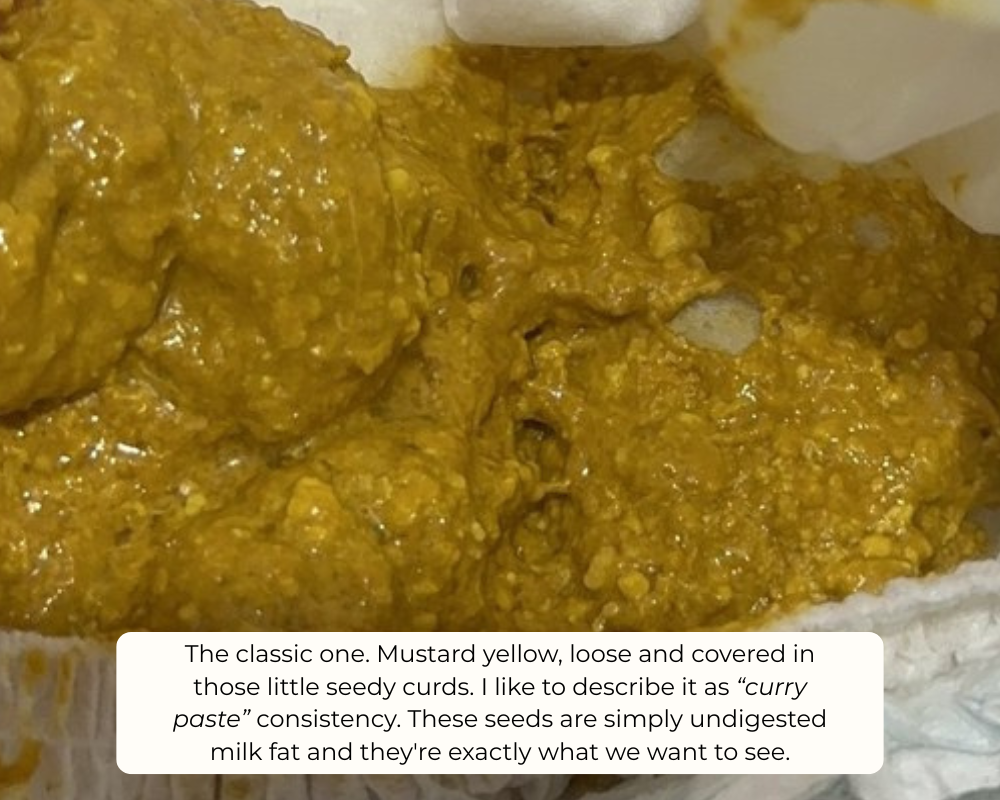
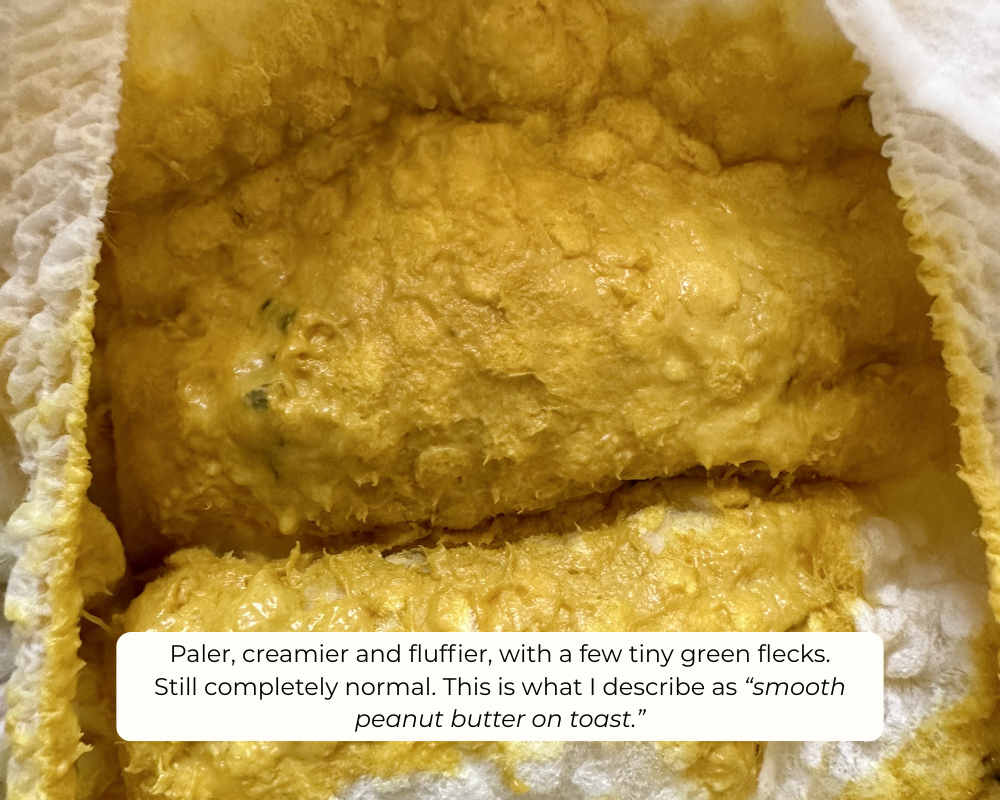
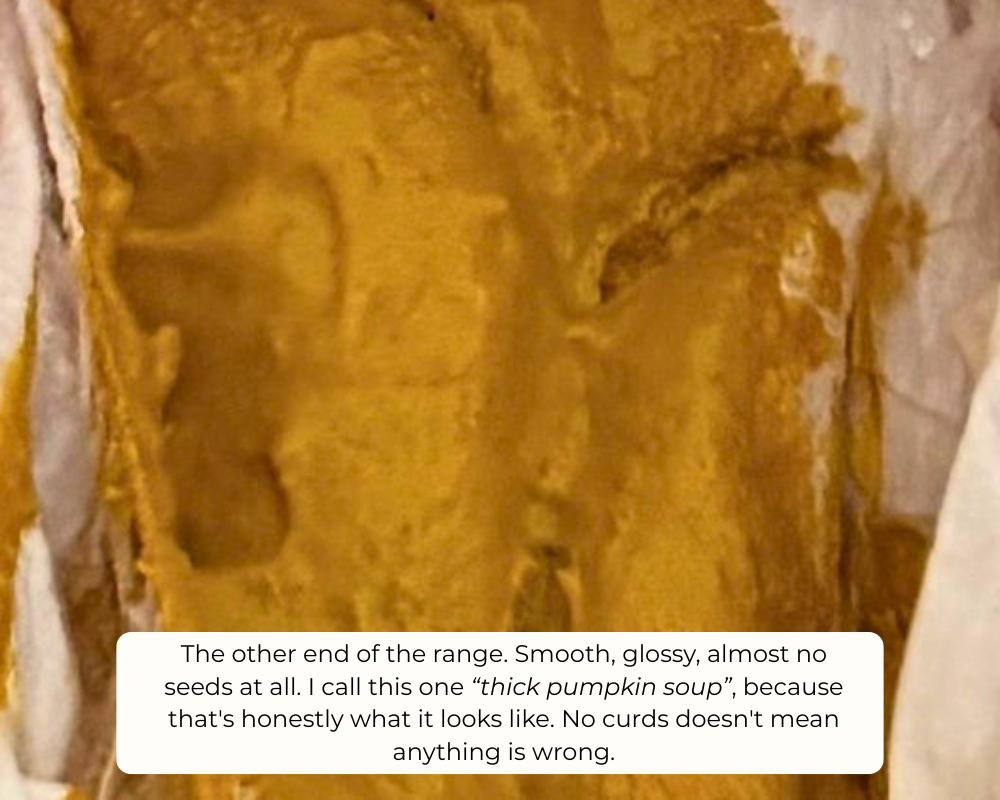
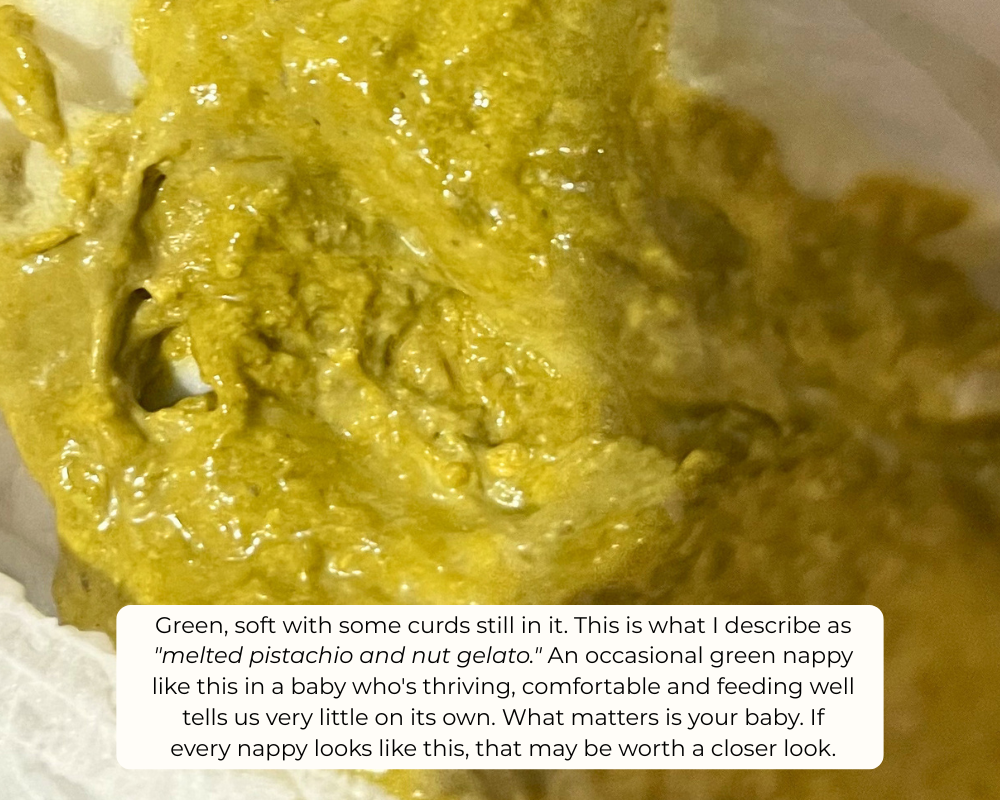
Beyond that, there's real variation. Some nappies are runnier than others. Some babies produce impressively explosive poops that require a full outfit change and a quiet moment of reflection. Others do tiny little squirts and that's their whole contribution for the afternoon. All of this can be perfectly normal in a thriving, comfortable, well-growing baby.
Is mucus in breastfed baby poop normal?
This is one of the biggest sources of panic I come across almost daily and I do believe it's because parents are told that mucus has no business being in a baby's nappy at all, especially in breastmilk poop.
But your baby's bowel produces mucus all the time. It's how the gut lubricates itself and keeps things moving comfortably and it isn't some foreign substance that's crept in from somewhere it shouldn't be. So seeing a little of it is not, on its own, the emergency it's often made out to be.
Small strings or fine wisps of mucus running through an otherwise normal nappy, in a baby who's feeding well, growing well, generally content and not presenting with any other signs or symptoms, I’m not usually concerned. They're common, and they come and go. A baby who's teething, drooling heavily or getting over a mild cold will often swallow enough mucus to produce exactly this and it means very little.
What does make me look more closely is when the mucus stops being wispy and starts being substantial.
I'm talking about jelly-like blobs. Long, thick, stringy pieces. The kind of mucus that stretches rather than breaks when you go to wipe it, in the way that thick stringy mucus does when you've got a proper head cold and you can't quite get rid of it. If you've seen it, you'll know exactly what I mean and I've never had a parent need me to explain it twice.
Mucus like that, particularly when it's persistent rather than the occasional one, is worth someone actually looking at your baby properly.
And here's the important bit. It doesn't tell us why on its own, it becomes a clue to our little detective work. Persistent mucus can turn up for a number of quite different reasons. Sometimes it relates to reflux and reflux itself has its own causes, from a baby swallowing excess air during feeds, to gut irritation after a course of antibiotics, to how a baby is feeding mechanically. Sometimes it relates to how the gut is coping with something. Sometimes it's part of a bigger picture that only makes sense once you look at the feeding, the wind, the reflux, the comfort, the growth and the nappies all together.
Which is exactly why I'd rather you had it looked at than tried to work it out from an article. If your baby is passing persistent mucus, especially alongside fussy feeds, wind, reflux or discomfort, that's a conversation with your IBCLC or GP. Not because it necessarily means something is wrong, but because a whole baby approach assessment can tell you what a photo on the internet never will.
There is one thing I don't want you to wait on, though, and it leads neatly into the next section.
The nappies that need a same-day phone call or visit
Now, while the range of normal is genuinely wide amongst babies, there are three flags that don't wait and I want these to be the part of this article you remember.
Black stools after the first few days of life. Meconium in the first days is expected and normal. Black stools appearing later are not and they need prompt assessment.
White, pale, chalky or clay-coloured stools. This is the one I most want parents to know, because it's easy to dismiss as odd rather than urgent. Pale stools can indicate a problem with how bile is reaching the bowel and time genuinely matters here.
Persistent blood throughout the stool. This is different from a single tiny occasional streak, which can come from a small anal fissure. Blood mixed through the stool or happening repeatedly, needs urgent attention.
These aren't things to work out from Google at midnight and they aren't things I'd want you to sit on or wait it out. They're a phone call to your GP or paediatrician and usually a same-day one. If it's after hours and you're worried, that's what urgent care or the emergency departments are for. Nobody will mind you coming in when you are concerned about your baby’s wellbeing.
How often should a breastfed baby poop?
This is where most of the confusion sits and it's a big enough question that I've written a whole separate blog on it.
The short version is that breastfed babies are designed to poop often. The largest piece of research we have, a meta-analysis by Baaleman and colleagues published in the Journal of Pediatrics in 2023, pulled together seventy-five studies covering more than sixteen thousand children. For breastfed babies in the first fourteen weeks, the average was around twenty-three bowel motions a week. That works out to roughly three a day.
So you've almost certainly heard someone say that breastfed babies can go up to ten days without pooping. It gets repeated constantly and it's simply not the everyday pattern for a breastfed baby. When the average is around three a day, ten days without a motion isn't the baseline we should be reassuring everyone with. It's the far end of the range and the far end of the range deserves a closer look rather than an automatic shrug.
A breastfed baby who goes every day or two and is comfortable, feeding well and thriving is absolutely fine. But a baby on milk feeds alone who's going four or more days with nothing, particularly if that's a change from how they used to be, is a baby I get curious about. Not alarmed. Just curious and I would like to start putting the pieces of the puzzle together.
Because a bowel habit that shifts is usually a bowel habit that's telling us something. If you want the full picture, including what the research actually shows and why I don't stop at "it's normal", it's all in my previous blog on the gastrocolic reflex.
When should I worry about my baby's poop?
Here's where I do start putting my thinking hat on, and it's worth saying that up front.
I don't expect a really offensive, putrid smell in an otherwise healthy, exclusively breastfed baby. If that appears, particularly if it arrives alongside other changes or symptoms, that's when I will start asking questions.
Not because the smell on its own means that I'm immediately worried or concerned. But because the smell is one clue sitting alongside all the others your baby may be showing. If the nappies have changed and the feeds have also become fussier, or reflux (or silent reflux) has appeared, or there's more wind and straining and discomfort, or your baby is swallowing more air, then that cluster of things is telling us something the smell alone never could.
None of these are diagnoses. They're clues, and clues are only useful when you read them together.
Every nappy tells part of the story
If there's one thing I hope you take from this article, it's that I never diagnose a baby from a nappy. I don't diagnose from any single symptom. I look at the whole picture, at how a baby is feeding, growing and sleeping, whether they seem comfortable, whether reflux has developed, whether they're swallowing air and above all, whether something has changed.
Because every symptom tells us something. We just have to be willing to listen to all of them at once, rather than one at a time.
Frequently Asked Questions About Breastfed Baby Poop
Is green poop normal in a breastfed baby?
An occasional green nappy in a baby who's thriving, comfortable and feeding well is usually nothing to worry about. Green comes in many shades and tells us very little on its own. If every nappy is green or it arrives alongside fussy feeds, wind or discomfort, then it may be worth booking in with an IBCLC and look a little closer.
Is mucus in breastfed baby poop a red flag?
Not usually. Your baby's bowel produces mucus constantly to lubricate itself, so small strings or wisps in an otherwise well baby are common. Persistent jelly-like blobs or long thick stretchy strings are worth having assessed by your IBCLC or GP.
What should healthy breastfed baby poop smell like?
Much milder than most parents expect. Parents commonly describe it as buttered popcorn, Greek yoghurt, fresh bread or simply sweet. That mild, slightly fermented smell comes from the gut bacteria breastmilk feeds.
How often should a breastfed baby poop?
Breastfed babies are designed to poop often. Research shows an average of around three bowel motions a day in the first fourteen weeks. Every day or two in a comfortable, thriving baby is fine. Four or more days without a poo on milk feeds alone is worth asking about.
Is it normal for a breastfed baby to go 10 days without pooing?
This gets repeated constantly, but it isn't the everyday pattern for a breastfed baby. Some healthy babies occasionally stretch out, but when the average is around three a day, ten days sits at the far end of the range and deserves a closer look rather than automatic reassurance.
What colour baby poop is dangerous?
Three colours need a same-day call to your doctor: black stools after the first few days of life, white or pale clay-coloured stools and persistent blood throughout the stool.
The Gentle Village take-home message
Healthy breastmilk poops can have a much milder smell than you're expecting, usually sweet or slightly sour or, yes, quite a lot like buttered popcorn. It's mustard yellow through to green, loose and seedy. There's a wide range of perfectly normal and a happy, comfortable, growing baby remains the most reassuring sign of all.
Black stools after the newborn days, pale or clay-coloured stools and/or persistent blood need a same-day conversation with your doctor. Everything else is worth watching and wondering about rather than panicking over.
Because although your baby has to poop and something that you have to frequently clean up…it is also one of the ways your baby communicates with you. Knowing what's normal, noticing when it changes and feeling confident enough to ask “why” is what helps you make good decisions for your little one.
Brenda's Clinical Reflection
I've come to think of nappies as a vital sign. Not the whole picture, but one of the things we assess, in the same way we'd check a temperature or a heart rate. A baby can't tell us their tummy hurts, or that milk isn't sitting well, or that they're swallowing air with every feed. But their gut can and it does, quietly, several times a day, in a nappy.
And like any vital sign, it means very little on its own. You'd never treat a baby on one reading. You look at the whole baby and you look at everything together.
That's why I ask about poop in every single consultation, even when parents look shocked or confused. It's rarely the thing that gives us the answer on its own. But it's so often the thing that tells us where to look.
If your baby's nappies have changed and it's arrived alongside fussy feeds, wind or reflux, that's exactly the kind of pattern worth understanding rather than waiting out. My guides and downloadable resources walk you through what to look for and how to start making sense of the whole picture.